


KANDAI
HEADLINES
- GLOBAL
Eyes focused on the world. Feet moving toward the future. Social impact that starts from Osaka
How OSIP CHANGEMAKERS are becoming global trailblazers
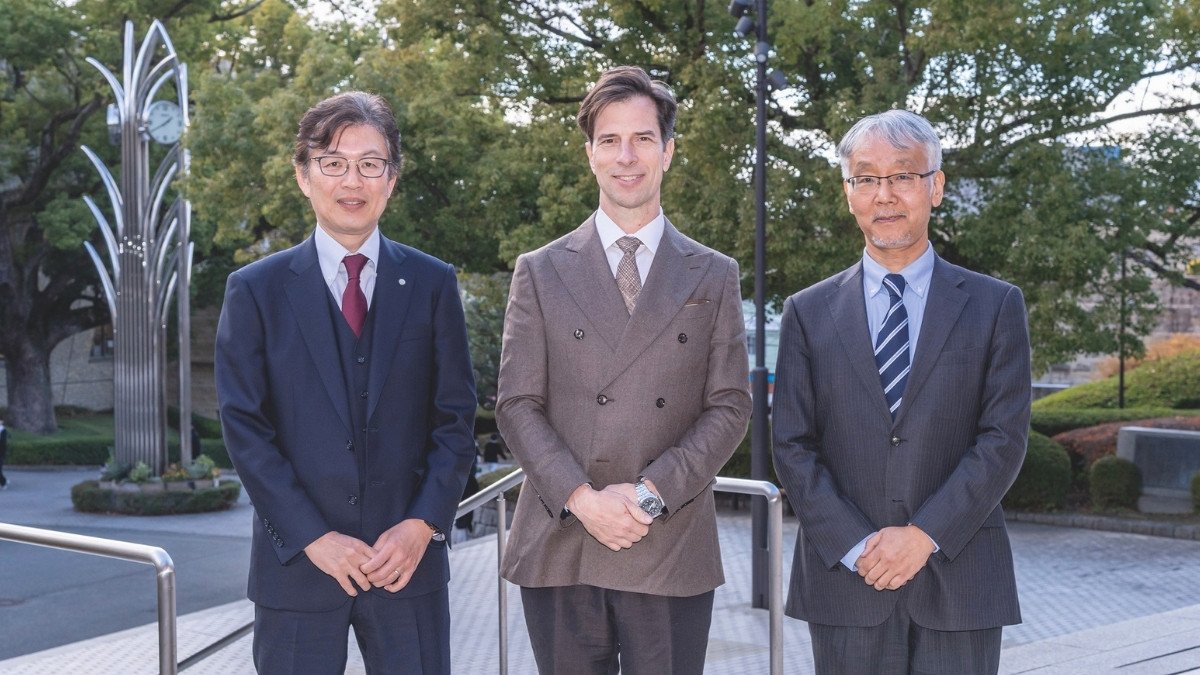
/Patrick Harlan (Pakkun), TV personality and visiting professor at Kansai University
/Masahide Takahashi, Vice President of Osaka Metropolitan University
/Osamu Takeuchi, Vice President of Kansai University
The "Osaka Changemakers: Issue-Driven Social Impact Co-creation Project" (OSIP) was selected for funding by the Ministry of Education, Culture, Sports, Science and Technology in fiscal year 2024.
With both Kansai University and Osaka Metropolitan University as partners in this endeavor, Vice President Osamu Takeuchi of Kansai University, and Vice President Masahide Takahashi of Osaka Metropolitan University, along with Patrick Harlan, affectionately known by audiences as "Pakkun," sat down to discuss human resource development, multicultural co-learning and other topics in the context of the OSIP project, which aims to cultivate the next generation of leaders who will transform society, starting from Osaka.
Overview of the Osaka Social Impact Project (OSIP)
The "Osaka Changemakers: Issue-Driven Social Impact Co-creation Project" ("OSIP"), which Kansai University applied for in collaboration with Osaka Metropolitan University in fiscal year 2024, has been selected for the Ministry of Education, Culture, Sports, Science and Technology's "Support Project for the Formation of Multicultural Co-educational Campuses for Creating Social Impact (Type I: Regional Collaboration Type)."
OSIP is an initiative based in Osaka that makes use of "cross-border learning" that transcends different cultures, fields, organizations, and environments to cultivate "changemakers" who will be the next generation of leaders to take ownership of the social challenges facing the next generation and who will take action to solve them.
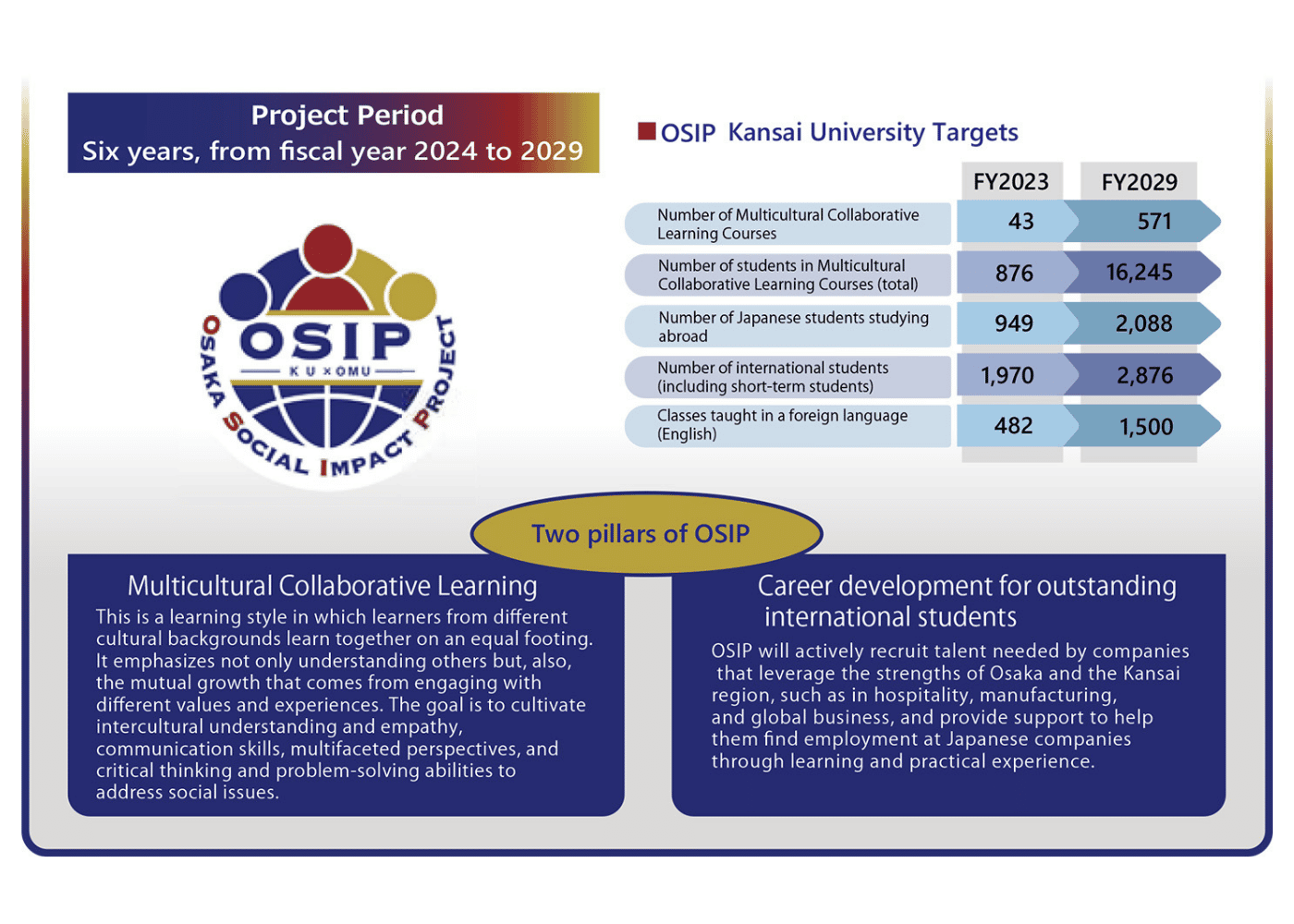
Collaboration between universities, local communities and the global community to solve problems
- Takeuchi
-
The "SI" in "OSIP" stands for "Social Impact." This may be an unfamiliar term. The reason this term is used is that this project aims to address various challenges facing modern society, with university students at the forefront, and, thereby, create a social impact originating from the university. Meanwhile, the term "Changemakers" refers to the next generation of leaders who take solution-focused action in order to create "change."
With Expo 2025 in Osaka, Kansai as a catalyst, Osaka is undergoing a transformation into an international city, but it also faces various local challenges, such as sustainably attracting inbound tourism, opening integrated resorts (IRs), and addressing labor shortages. As part of this project, Japanese students and international students explore solutions to these challenges, for example, through "multicultural co-learning." Learning to address social challenges is not enough if it is only discussed in a classroom. It is also necessary to try to implement solutions in society in order to make an impact. Therefore, OSIP is collaborating with Osaka Metropolitan University, which has strong ties with local governments and acts as an urban think tank, and Kansai University, which has a strong network with local companies. Together with the government and industry, they will design learning experiences that allow students to gain experience in solving real world problems. - Pakkun
- What sort of learning is OSIP's multicultural co-learning?
- Takeuchi
-
Multicultural co-learning is a learning style in which people from different cultural backgrounds learn together on an equal footing. When Japanese students study alone, their thinking tends to become one-sided, but the inclusion of international students adds diverse perspectives, greatly broadening the scope of ideas and thinking. It is not easy to discuss and reach agreements with people from different cultural and linguistic backgrounds. However, it is this process that leads to the development of a wide range of abilities, including not only English proficiency, but also creativity, critical thinking, and communication skills.
We hope that international students will view their studies in Japan as a career path to success on the world stage, and that Japanese students will see their multicultural co-learning experience as a step towards spreading their wings and venturing out into the world. From overseas to Japan, and from Japan to overseas - the receiving and sending of students works together in a virtuous cycle. OSIP is a concept that looks beyond Japan, with an eye on human resource development both domestically and internationally. - Pakkun
- I see. That's a terrific initiative.
- Takahashi
- When Kansai University approached us about OSIP, it was around the time that Osaka Metropolitan University was beginning to promote university-wide internationalization, and we felt that participating in OSIP would be an opportunity to accelerate that trend. Thinking about local issues in Osaka also means thinking about our connection to the world. Furthermore, advancing social co-creation initiatives through OSIP is of great significance for both students and us researchers. We decided to participate in OSIP from a desire to, in collaboration with Kansai University, cultivate "changemakers" who would change the world, starting from Osaka.
- Pakkun
- Can any student take OSIP courses?
- Takeuchi
- At Kansai University, "multicultural co-learning courses" based on the OSIP concept are being expanded not only to university-wide general education courses but, also, to specialized courses in all faculties. Students can select and take "multicultural co-learning courses" from their faculty's specialized courses and university-wide general education courses.
- Takahashi
- Osaka Metropolitan University also offers multicultural co-learning courses as part of its regular curriculum.
- Takeuchi
- At Kansai University, we are working to improve our compulsory foreign language courses, which are taken by approximately 14,000 students in total, by incorporating elements of multicultural co-learning. In addition to regular classes, we are also enriching our programs outside of class, and, through OSIP, we are comprehensively promoting the internationalization of the entire university.
- Pakkun
- It sounds like this project allows many students from Kansai University and Osaka Metropolitan University to participate, which fosters individuals who have an international perspective while making an impact on the local community.

"Multicultural co-learning" creates new ways of thinking
- Pakkun
-
I believe that learning by interacting with people whose native language is not Japanese is extremely important. Even a halting conversation with someone can still help you hone your ability to immediately pick up on others' cultural background and desires. Also, if you can't find a foreign language word that perfectly matches the word that comes to mind in your native language, you have to take a mental detour to rephrase it in a more appropriate way. This trial and error, this maze of exploration, is what trains your brain and thinking. Learning expressions that don't exist in your native language is like learning concepts that don't exist in your home country. My personality changes when I speak Japanese, but the fact that I, an American, can now smoothly switch gears from an English-speaking brain to a Japanese-speaking brain is proof that my brain has grown accordingly. I think that acquiring a foreign language is like increasing the specs of your brain's CPU.
Also, when engaging in debate and discussion with people from diverse countries, you cannot provide convincing explanations unless you have a proper understanding of your own culture and background. Often, when communication breaks down, the cause is not a language barrier but a "cultural barrier." For example, in Japan, you often see signs that say "No private conversations." When several American friends came to Japan, I explained the meaning of "No private conversations," and they were all surprised, saying, "It's strange to prohibit private conversations," and the "No private conversations" sign ended up becoming the trigger for private conversation (laughs). Even if the English translation, "No Private Conversation," is understood, the cultural concept behind it is not immediately conveyed. One aspect of international exchange is that it provides an opportunity to make discoveries that transcend language and to encounter new concepts. - Takeuchi
- Pakkun is exactly right, it really does change how you see the world.
- Pakkun
- Also, foreigners often question things that are taken for granted in Japan. If clear reasons cannot be provided in response to these questions, this may indicate that, even for Japanese people themselves, there is room for systemic or structural improvement and that this could be a source of new innovation. I believe that developing a perspective that questions the assumption that something is "obviously true" is a great advantage when living in a diverse society.
- Takahashi
- I feel that what Pakkun is talking about touches upon the issue of individual identity. The reason Americans can frankly question the "no private conversation" rule is probably because they feel confident in their own culture and identity. I hope that Japanese students will, from a place of strong self-esteem as Japanese, engage with non-Japanese people to actively discuss their questions. Without this kind of cross-cultural attitude and thinking, changemakers will not be born. Great learning can result from small insights gained through multicultural co-learning. I believe this is the significance of OSIP.
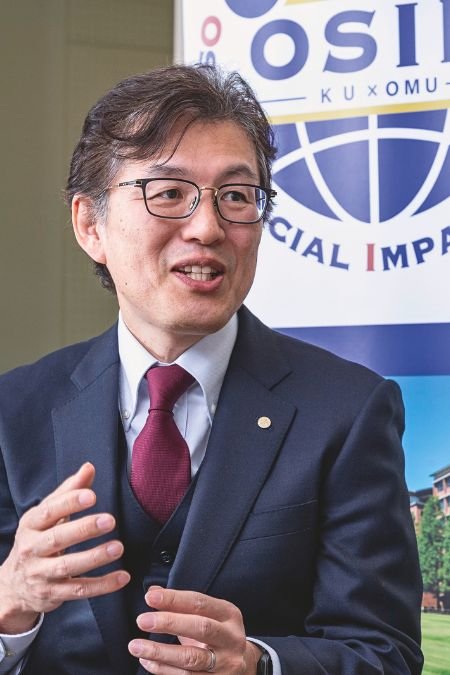
Accumulating small successes increases one's sense of self-efficacy
- Takeuchi
- I feel that Japanese students tend to hesitate to study abroad because they can't take that "extra step." Perhaps Japan is just too comfortable to live in? What are your thoughts, Pakkun, on how to convey to students the importance and excitement of venturing into different cultures?
- Pakkun
-
First and foremost, I want to clearly communicate to students the true value and importance of studying abroad. The study-abroad experience can enhance critical thinking and communication skills, and, by getting to know others, it allows you to gain a more objective perspective on your own culture and values. As was the case for me, you might even discover a new place where you feel you can truly contribute. Studying abroad is an opportunity to rediscover yourself and an experience that leads to personal growth.
Also, a more fundamental issue is the impression that there are few ambitious young people in Japan. Perhaps a burning desire to "succeed," "achieve something," or "amaze the world" lies dormant deep within their hearts, but it is kept bottled up. When considering how to cultivate that strong spirit, starting at university might be a little too late. Americans are told too often from a young age that "you are amazing" and "you can change the world," which can make some people overconfident (laughs), but, conversely, Japanese people are too humble, and I feel that they need those magical words. I hope that we can consistently cultivate highly motivated individuals with a strong sense of self-esteem, possessing both high aspirations and humility, from kindergarten to graduate school, and produce them not only for Japanese society but also for the world. - Takeuchi
- Since Kansai University has institutions ranging from kindergarten to graduate school, the responsibility really is immense.
- Takahashi
- While it's certainly important to cultivate ambition from a young age, I believe there are aspects that can be nurtured even at university. For example, experiences such as having a paper from an international collaborative research project published in a high-impact factor (IF) academic journal, or receiving an award at an international conference, foster a student's ambition by allowing them to feel recognized abroad.
- Takeuchi
- Because Japanese people have few experiences of success abroad, they may lack a sense of "self-efficacy," that is, the belief that "I can do this." OSIP wants participants to build on small successes and connect them to bigger experiences. For example, they can start by achieving success in addressing local challenges, then expand their activities overseas, take on challenges such as presenting at international conferences and addressing problems on the ground, thereby increasing their sense of self-efficacy. In other words, education that fosters ambition is needed in Japan.
- Pakkun
- To add one more point, these days you can engage in international activities without having to venture out into the world. For example, if a Japanese swordsmith creates swords that are loved all over the world, that is a fine example of international activity. Japanese people are inherently very diligent and active, so all they need to do is look beyond Japan and towards the world, and take that first step. I don't think there is a clear boundary between "domestic people" and "international people."
- Takeuchi
- Professor Takahashi, how do you envision developing individuals who can thrive on the international stage?
- Takahashi
- In our world, the question is whether you have your own opinions. First and foremost, we must cultivate individuals who can express their own opinions and views accurately and confidently. This is an area where Japanese people tend to struggle. Furthermore, I believe it is the responsibility of universities to send out individuals into society who possess not only language skills but also a high degree of expertise and specialization.
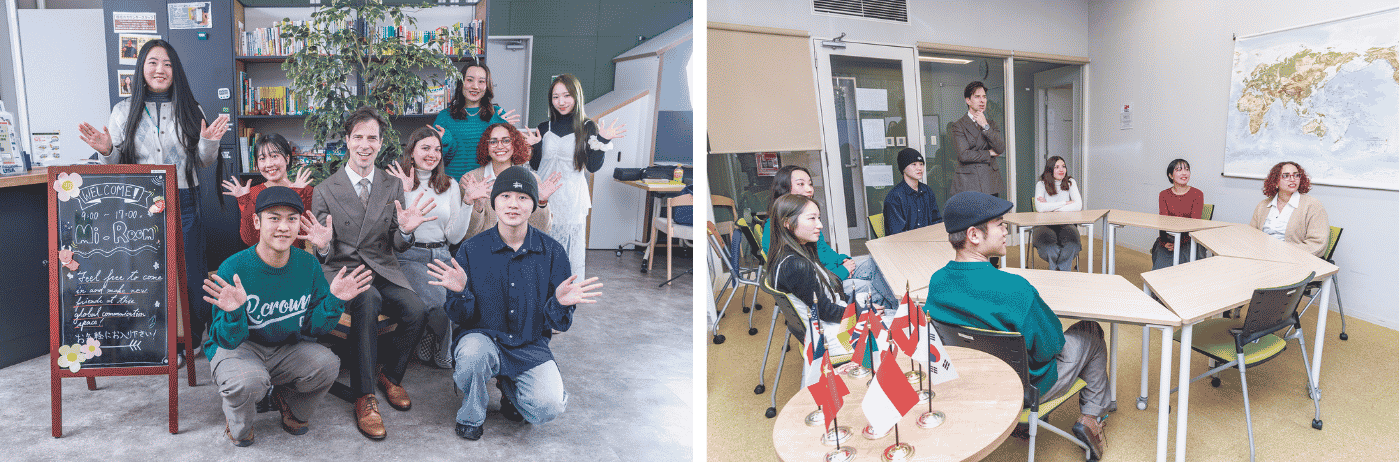
How to address hesitancy towards diversification
- Takeuchi
- In Japan, as a policy to compensate for labor shortages caused by the declining birthrate and aging population, a certain number of technical trainees and immigrants are accepted. At the same time, however, I feel that resistance to foreigners and people with different values is also spreading within society. What is your take on this situation, Pakkun?
- Pakkun
- I feel that anti-immigration sentiment is growing stronger not only in Japan but in many other countries as well. It's natural that resistance arises when social change is too rapid. Throughout history, movements to exclude various societal changes and activities, such as those related to race, sexual minorities, and feminism, have repeatedly arisen. I don't think we should simply label all of this resistance as hate. I believe that if we can engage in careful dialogue and embrace the appeal of diversity, rather than speaking in terms of binary opposition, i.e., "for" or "against," Japan can become an even richer and more interesting country. Foreigners who come to Japan are people who are interested in Japan, a country I love. Naturally, thinking about that makes me happy. It would be ideal if the whole world could be interested in races and cultures other than their own and, thus, come to understand one another. As a step towards sustainable coexistence, it would be great if humanity as a whole could cultivate this kind of tolerance.
- Takeuchi
- Immigration issues are intertwined with various other social issues. I believe Japan is at a point where careful dialogue amongst people who hold diverse values is needed as we work to resolve these issues before they escalate. Exchanges that transcend national and cultural boundaries have the potential to foster growth not only in ourselves but also in society as a whole. I hope that students will start by developing an interest in different cultures, cultivate an international perspective, and adopt a flexible mindset when working to address social challenges.
- Takahashi
- In Germany, the "Immigration Law" was enacted in 2005, legally mandating employment support for immigrants. They are expected to contribute to the workforce in a society facing a declining birthrate and aging population, learning not only the German language and vocational training but also the country's customs and systems. Despite this, anti-immigration movements are still growing. This is attributed to the fact that the benefits of the system are not sufficiently reaching the entire population, thus hindering the ability of the system to function effectively. And for German citizens, the issues of culture and rules are crucial. If one chooses to emigrate to another country, it is essential to understand and respect the culture and rules of that country.
- Pakkun
- Japanese rules can be difficult in some respects for foreigners to understand.
- Takeuchi
- That's why explanation and dialogue sufficient for achieving understanding are important. When talking with international students, I believe that carefully explaining the background, rather than assuming they will understand without me having to explain everything, ultimately leads to a mutual understanding of cultures.
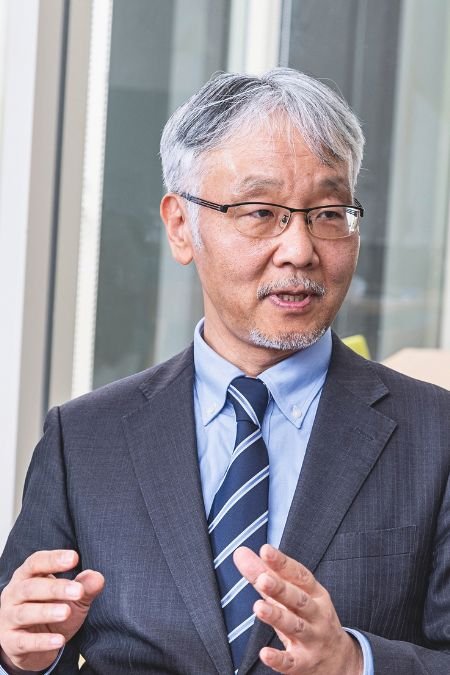
Going beyond template-based education to tackle questions with no single right answer
- Takeuchi
- Finally, what message do you have for the students?
- Pakkun
-
The first thing I want to tell young people in Japan is that you don't have to simply accept the status quo. If you feel that something needs to change, don't hesitate to pursue change. There's an English saying, "Necessity is the mother of invention," but it isn't just "necessity" but also "desire" and "want" that drive invention. While it's true that patience is a virtue, I don't want young people in Japan to feel that they have to shoulder everything on their own.
Education in Japan has many excellent aspects, such as fostering basic academic skills and teamwork; however, I feel it's an education system where you can arrive at the correct answer and get a perfect score by simply following a template. In the real world, there are countless problems without right answers. Given that, achieving a high level of results and innovation requires the ability to think critically, to debate, and to form one's own opinions. I believe the ability to confront problems that don't have easy answers is precisely what education needs going forward. - Takeuchi
- It's true that, in Japanese education, teachers often prepare the answers beforehand, and students believe that only those answers are correct and try to guess them. Becoming accustomed to this pattern makes it difficult to deal with problems and issues that don't have a single correct answer. That's a significant problem. OSIP classes tackle social issues that don't have a single right answer. It's not about getting a perfect score. The students work on the process of building a consensus that leads to the optimal solution for the given context.
- Takahashi
- Both Kansai University and Osaka Metropolitan University provide an environment where students can take on challenges, so I hope you will make the most of your time at university. By proactively seizing these opportunities, I hope you will become individuals who can thrive anywhere in the world.
- Takeuchi
- Through OSIP, we hope to develop participants' empathy (the ability to think from another person's perspective). We aim to cultivate individuals who possess "cross-border thinking," i.e., the ability to discuss differences in values and perspectives without fear and with respect and understanding for those differences, as well as the ability to engage in "unhesitant action."
- Pakkun
- Whether you choose to learn a foreign language, emigrate abroad, or become a global citizen, the path you take in this increasingly diverse world is entirely up to you. If you acquire specialized skills and expertise and gain the confidence to succeed in any place or field, you will surely be able to lead a fulfilling life no matter which path you choose. I sincerely hope you will make the most of OSIP and expand your own possibilities.
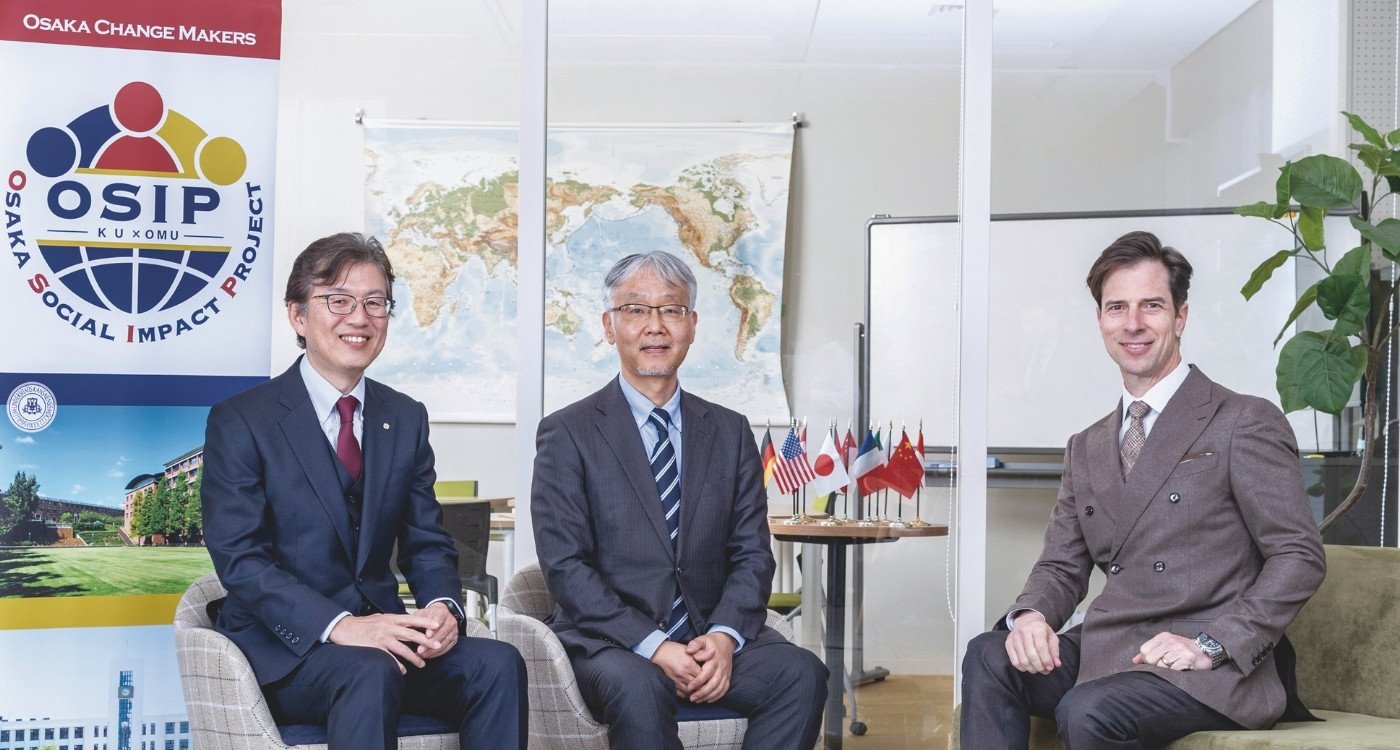
From Osaka to the World: OSIP Fosters the Power to Tackle Social Issues
In Japan, structural challenges focused on the future are becoming increasingly serious, such as labor shortages due to a declining birthrate, an aging population, and shrinking regional economies. What is needed in the midst of such change is the ability to understand diverse values and tackle challenges in collaboration with people from various countries.
Kansai University is promoting internationalization in response to these social needs. In 2014, it pioneered the introduction of "Collaborative Online International Learning (COIL) type education" nationwide. In 2018, this COIL-type education was selected for the Ministry of Education, Culture, Sports, Science and Technology's "Inter-University Exchange Project," and, in 2023, the "BM (Blended Mobility)" initiative, conducted in collaboration with Tohoku University and Chiba University, was also selected for the same project. Furthermore, through the "SUCCESS - Osaka" program, a Ministry of Education, Culture, Sports, Science and Technology-commissioned project to promote employment for international students, Kansai University has been working to provide career support for international students.
Drawing on this know-how, OSIP aims to contribute to the international community by fostering human resources in Osaka, a city developing as a global and Asian international city, who adopt an issue-driven approach (i.e., thinking which revolves around, and is focused on addressing, issues), cross-border thinking, and unhesitant thinking.
- Patrick Harlan
- Comedian. TV personality. Commentator. Harlan graduated from Harvard University with a degree in Comparative Study of Religion in 1993. That same year, he came to Japan and worked as an English conversation school instructor, among other things. In 1997, he and Makoto Yoshida formed the comedy duo "Pack'n Mack'n." He is affectionately known by audiences as "Pakkun." Harlan is active in a wide range of fields including television, radio, and media events. He is a part-time lecturer at Institute of Science Tokyo. He serves as a visiting professor at Ryutsu Keizai University. In 2025, he became a visiting professor at Kansai University. His numerous books include The Art of Solo Diplomacy for Competing with the World (Mainichi Shimbun Publishing) and Pakkun's Textbook on 'How to Communicate and Speak': Raising Children Who Can Succeed Globally (Daiwashobo).
- Masahide Takahashi
- Vice President of Osaka Metropolitan University. In 1996, Takahashi completed the doctoral program in Materials Science at Kobe University's Graduate School of Natural Science. After serving as a postdoctoral fellow at the Toyota Technological Institute's Graduate School of Engineering, a researcher at Kobe University's Venture Business Laboratory, and an associate professor at Kyoto University's Institute for Chemical Research, he became a professor in Osaka Prefecture University's Graduate School of Engineering in 2009 and a professor in Osaka Metropolitan University's Graduate School of Engineering in 2022. He has served as a visiting professor at universities in Italy, Brazil, Austria, and China. He has received numerous awards, including the 2011 Ceramic Society of Japan Academic Award and the 2021 Chemical Society of Japan Academic Award. He has held his current position since 2025.
- Osamu Takeuchi
- Kansai University Vice President and Dean of the Division of International Affairs. Takeuchi graduated from Kobe City University of Foreign Studies Graduate School in 1987. In 1992, he completed his graduate studies at the Monterey Institute of International Studies in the United States with a Fulbright Scholarship. In 2005, he received his PhD in Education from Hyogo University of Teacher Education's Joint Graduate School in the Science of School Education. After various teaching positions, including in the Faculty of Liberal Arts at Doshisha Women's College of Liberal Arts and the Faculty of Informatics at Kansai University, Takeuchi became a professor in the Faculty of Foreign Language Studies and the Graduate School of Foreign Language Education and Research at Kansai University. He has served as Dean of the Faculty of Foreign Language Studies, Dean of the Graduate School of Foreign Language Education and Research, Trustee of Kansai University, and Member of the Osaka Prefectural Board of Education, among other positions. He has also received such awards as the JACET Award for Outstanding Academic Achievement and LET Award of Outstanding Academic Achievement. He has held his current position since 2024.
Related articles
-
Bridging Theory and Practice in International Cooperation...
-
Eyes focused on the world. Feet moving toward the future. Social ...
-
Studying Creole Culture in Cabo Verde, an African Island Nation...

-
An OB-GYN who supports women throughout their lives...

-
Captivated by the beautiful, musical sound of Japanese...

-
Japanese Animation Crosses Borders

- TOP
- About Kansai University
- Public Relations
- List of Headlines
- Headline Article