2026.03.09アドバンストプログラム
Spring 2026 MCP Course on Design Thinking Successfully Completed
Kansai University is pleased to announce the successful completion of the February J-MCP (Japan-Multilateral COIL/VE Project), an intensive international learning program that ran for approximately three weeks and brought together students and faculty from across the globe.
The project focused on Design Thinking as its central theme and was led by Prof. Markane Sipraseuth of Kansai University. Teaching was also provided by Prof. Aisyah Astari, Prof. Adrian Bercea, and Prof. Andrew Sowter, who guided students through a series of interdisciplinary lectures designed to support creative problem-solving and innovation.
The program also benefited from the collaboration of Prof. Hisa Martinez Nimi and Prof. Juan Carlos Chacon from Chiba University, who delivered special lectures on Design, Communication & Technology. Additional topics explored throughout the project included Leadership, Cross-Cultural Communication, the SDGs, Critical Thinking for the Digital Age, and Neurodiversity and Creativity, each helping students shape their own vision for a prototype solution.
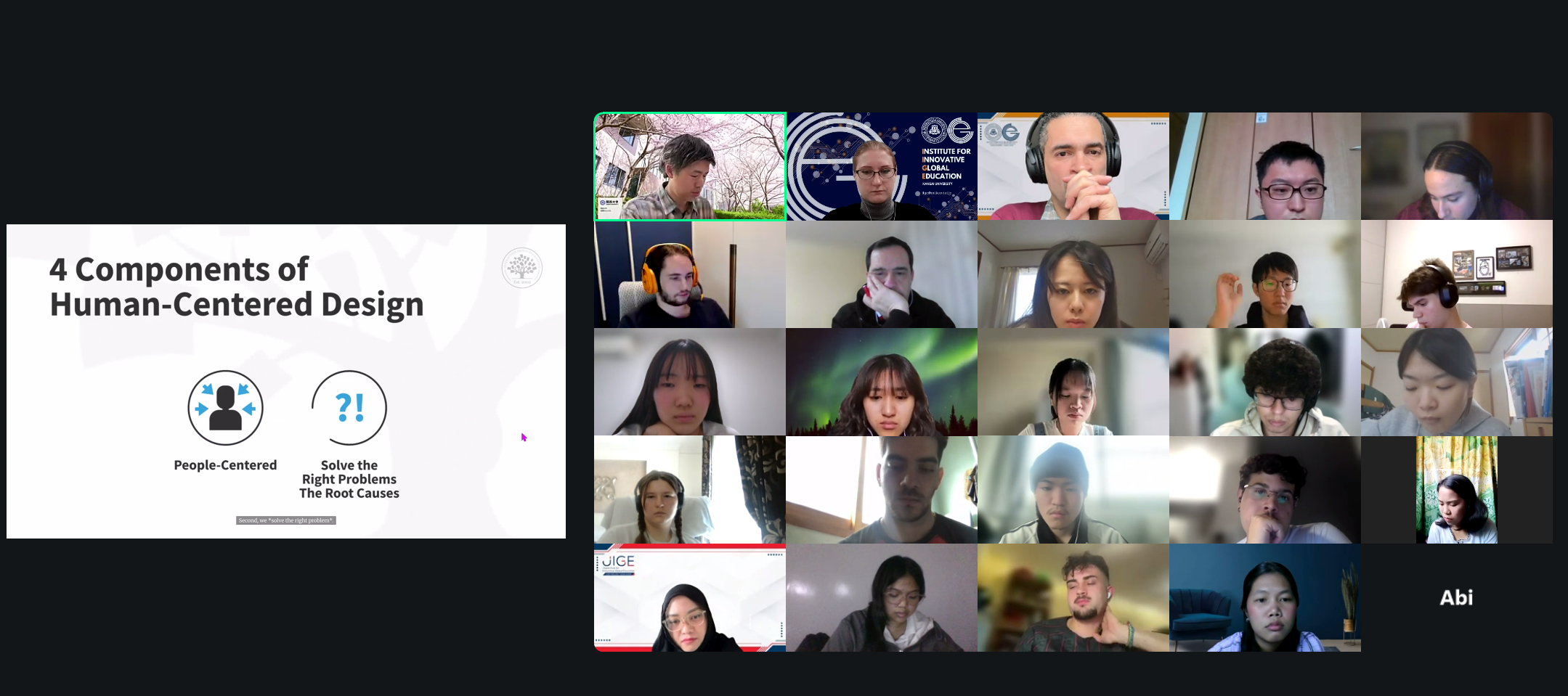
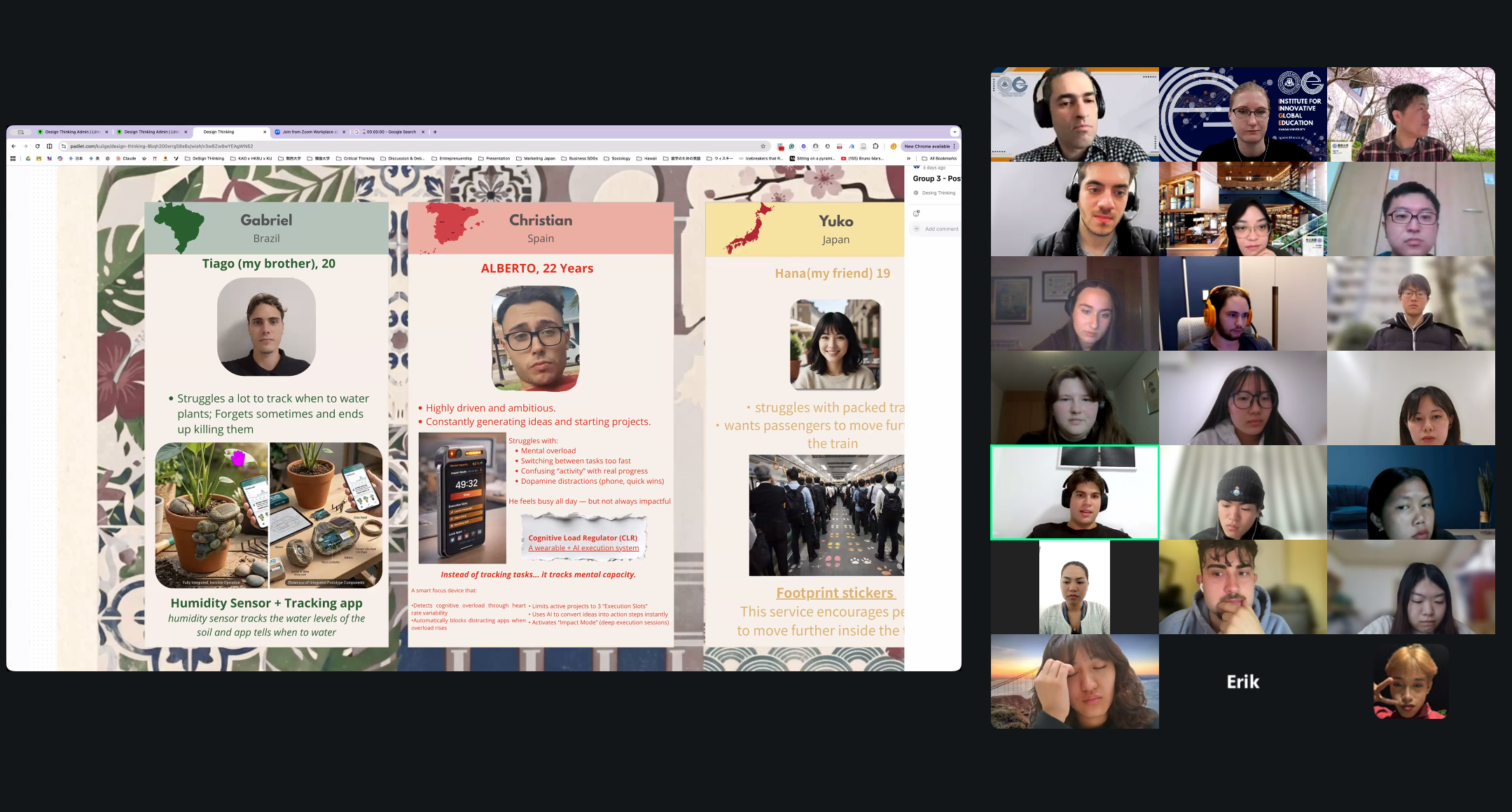
Over the course of ten online sessions, students worked in international teams to develop a prototype product using the Design Thinking methodology. Guided by Prof. Sipraseuth through the five phases of the Design Thinking process, students experienced the importance of empathy as the foundation for understanding users and designing meaningful solutions. Their prototypes were very diverse, including solutions such as reducing stress for a deaf classmate in the classroom, designing a sensor-based plant-watering system, creating a simple and enjoyable recipe to ease a parent’s anxiety, and reimagining train crowd movement to reduce congestion and commuter stress. They highlighted how empathy-driven design can address real-life challenges in practical ways.
Participants represented Kansai University as well as universities from across Japan and internationally, including students from Brazil, the Philippines, Spain and the US. The program concluded with a final presentation session in which teams showcased their prototypes and reflected on their collaborative journey.
Student feedback highlighted the strong impact of the experience. One participant shared that the project helped develop “critical thinking and empathy skills,” while another noted that Design Thinking is “a human-centered, iterative learning process rather than just a creativity method.” Several students emphasized the value of international teamwork, with one reflecting that the project “transformed me from a passive learner into a human-centered problem solver.”
Through collaboration, creativity, and cross-cultural dialogue, the J-MCP Project demonstrated how global learning environments can inspire the next generation of innovators.
Selections of feedback and reflections from students
“As a learner, this project was excellent to develop my critical thinking and also my empathy skills. It showed me that we all have to be patient and understand each other in order to provide the best for our clients and people.”
“After completing the project, I now define Design Thinking as a human-centered, iterative learning process rather than just a creativity method. It is not about having the best idea, but about understanding the user deeply, reframing the problem correctly, and testing assumptions early.”
“Through this project, My way to learn something would change. In Japan, we have to memorize something in class. In other words, I have been learning something by myself. Even in university, there are few chances to cooperate with students from other nations. For example, in my department, All I have to do in most classes is taking tests or submitting reports. Some classes are required to participate in experiments, which are individual tasks. This project makes me understand how to learn something together and cooperate with each other.”
“Overall, this project changed me as a learner by teaching me that true innovation requires stepping out of my comfort zone, listening deeply to users, and embracing the diverse perspectives of a global team.”
“I really enjoyed working together with a group of people from diverse backgrounds. There were quite a few differences between us, but we had a good time connecting, sharing stories, and working together.”
“One key skill I developed during this project was empathy. Through the design thinking process, I learned how important it is to truly understand the perspectives, needs, and challenges of the people we are designing for. Instead of immediately jumping to solutions, I became more intentional in listening, asking thoughtful questions, and considering the user’s context.”
“The lectures were very stimulating, and the "AI persona" activity was a very creative way to explore different user perspective.”
“This project transformed me from a passive learner into a human-centered problem solver. I learned that true learning happens through empathy and the courage to engage in difficult conversations, even when language is a barrier.”