
Philosophy and Concept
With keywords of chemistry, life sciences, and materials, we cultivate researchers and engineers who can contribute to the development of 21st-century "manufacturing" and "advanced technology."
Learning and research content includes "design and invention of new molecules and materials" and "elucidation and application of the functions of biomolecules such as DNA and proteins" required by various advanced technology fields.
We aim to cultivate researchers and engineers who can respond to a wide range of fields including nanotechnology, biotechnology, energy, environment, and medicine. The academic field that discovers and creates unprecedented "things" and protects people's lives and well-being will surely provide a sense of fulfillment.
What You Can Do at the Faculty of Chemistry, Materials and Bioengineering
Six Research Fields Opening Up the Future
The Faculty of Chemistry, Materials and Bioengineering cultivates human resources who contribute to society through cutting-edge research!
Next-Generation Energy Storage Technology
Realize an energy-saving society with materials that can store hydrogen compactly, lightly, and safely, and high-output, high-capacity batteries.
Artificial Organs & Medical Materials
Develop materials with less burden on the body. Support medical progress from organ transplantation to the era of regenerative medicine.
Care & Welfare Equipment
Research low-cost metal materials that are easy for elderly people to use, light, strong, and gentle on the body.
Creation of New Pharmaceuticals
Decode the genetic sequences of microorganisms to create new pharmaceuticals. Help people around the world suffering from intractable diseases.
Healthy Life Expectancy Extension
Develop efficient culture technology and increase the productivity of lactic acid bacteria to contribute to healthy life expectancy extension.
Safe Cosmetics Development
Create new substances by applying biological mechanisms and develop safe cosmetics that can be used on sensitive skin.
Learning at the Department of Chemistry and Materials Engineering
Cultivate human resources who lead advanced technology with skills to create new substances and materials
Materials Science
Learn materials science that maximizes the functions of "things" and imparts new functions. Aim for research and development of materials suitable for a circular society with low environmental impact. Research includes hydrogen storage materials, bone-like substance film formation by light irradiation, and plasma nitriding technology.
Applied Chemistry
Cultivate chemists who support high-tech industries and contribute to solving environmental, energy, health, and food problems. Acquire molecular design methods for target substance synthesis and the ability to understand substances at the molecular and molecular assembly level. Research includes next-generation batteries, ionic liquids, and nano-sized metal nanoparticles.
Biomolecular Chemistry
Train researchers who contribute to the development of medical and life sciences from a chemistry standpoint. Acquire the ability to design and synthesize new molecules and polymer materials that work on biomolecules such as proteins, polysaccharides, and DNA, as well as cells and biological tissues themselves. Research includes intelligent gels and cell microarrays.
Semiconductor & Microfabrication Technology
Work on semiconductor circuit miniaturization that supports performance improvement of electronic devices such as smartphones. Develop "resist materials" that react with high sensitivity to extreme ultraviolet light (wavelength 13.5nm), and pursue the possibility of greatly improving semiconductor performance and production efficiency.
Learning at the Department of Life Science and Biotechnology
Cultivate human resources who can be active in multiple fields such as food, pharmaceuticals, cosmetics, and environment
Life Science
Understand the structure and function of DNA and proteins, and learn about higher-order life phenomena based on their interactions. Cultivate abilities that can be widely applied to food and pharmaceutical development and basic research. Work on creating new pharmaceuticals by decoding microbial genetic sequences and developing safe cosmetics.
Bioengineering
Learn technologies that apply biological functions to engineering, such as plant breeding and substance production using microorganisms. Develop efficient culture technology for lactic acid bacteria and increase productivity to contribute to healthy life expectancy extension. Advance research in fields such as environmental microbial engineering, enzyme engineering, and biochemical engineering.
Plant Biotechnology
Aim for application in agriculture and food fields through plant cell engineering and plant molecular biology. Conduct research contributing to the realization of a sustainable society using the latest biotechnology such as developmental biology, biophysical chemistry, and bioinformatics.
Pharmaceuticals & Diagnostic Materials
Learn pharmaceutical pharmacology, protein engineering, bio-instrument analysis, and work on the development of medical and diagnostic materials. Contribute to improving intractable disease treatment and diagnostic technologies through the creation of new substances applying biological mechanisms. Cultivate human resources who can be active in food-related companies, pharmaceutical research and development companies, and medical institutions.
Global Human Resource Development Program
Acquire international sensitivity and multifaceted perspectives
Overseas Training Program (10 days)
- Partnership program with partner universities in Thailand during summer vacation
- University lectures, laboratory tours, exchanges with local students
- Visits to Japanese companies
Short to Medium-term Study Abroad Program (1-3 months)
- Basic experiments in laboratories in the United States, Thailand, etc.
- Participation in seminars, exchanges with local students
- Cultivation of international sensitivity through diverse activities
- Realize the universality of learning and research after completion
Department Introduction
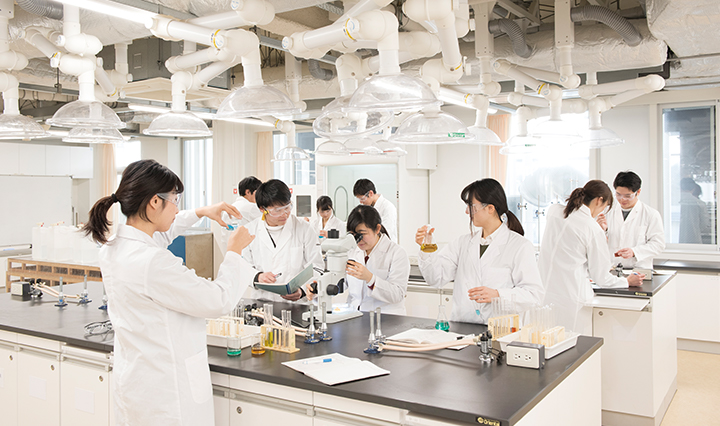
Department of Chemistry and Materials Engineering
Capacity: 242 students
Aim to contribute to the development of science and technology through diverse "manufacturing" such as functional design and creation of new substances and materials, and development of process technologies for their production. Research subjects span a wide range including atoms, molecules, polymers, crystalline and amorphous solids (metals, ceramics, glass, semiconductors, etc.), and composites made by combining them.
Materials Science Course: Train materials scientists. Aim for research and development of materials suitable for a circular society.
Applied Chemistry Course: Cultivate chemists who contribute to solving environmental, energy, health, and food problems.
Biomolecular Chemistry Course: Train researchers who contribute to the development of medical and life sciences from a chemistry standpoint.
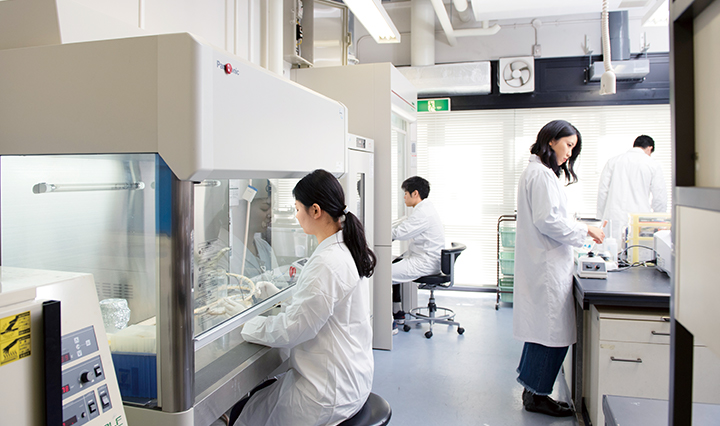
Department of Life Science and Biotechnology
Capacity: 105 students
Understand the structure and function of DNA and proteins, learn about higher-order life phenomena based on their interactions, and cultivate abilities that can be widely applied to food and pharmaceutical development, basic research, and plant breeding. Cultivate human resources who can be active in multiple fields such as food, pharmaceuticals, cosmetics, and environment.
Life Science Course: Understand the structure and function of DNA and proteins and apply to food and pharmaceutical development and basic research.
Bioengineering Course: Learn technologies that apply biological functions to engineering, such as plant breeding and substance production using microorganisms.
Expected Future Career Fields
Department of Chemistry and Materials Engineering (Capacity: 242 students)
Materials Science Course
- Metal and Ceramics-related Companies
- Electronics-related Companies
- Automotive-related Companies
- Industrial and Precision Machinery-related Companies
- Environmental and Energy-related Companies
- Medical and Welfare Equipment-related Companies
Applied Chemistry Course
- Chemical Industry-related Companies
- Pharmaceutical-related Companies
- Automotive-related Companies
- Food-related Companies
- Environmental and Energy-related Companies
- Electrical/Electronic Devices and Semiconductor-related Companies
Biomolecular Chemistry Course
- Pharmaceutical and Cosmetics-related Companies
- Food and Biotechnology-related Companies
- Environmental and Energy-related Companies
- Medical and Diagnostic Materials-related Companies
- Chemical Industry-related Companies
- National, Public, and Private Research Institutions
Department of Life Science and Biotechnology (Capacity: 105 students)
Life Science Course
- Pharmaceutical-related Companies
- Cosmetics-related Companies
- Food-related Companies
- Medical-related Companies
- Environmental-related Companies
- Junior High and High School Teachers
Bioengineering Course
- Food-related Companies
- Pharmaceutical Research and Development Companies
- Medical Institutions
- Chemical and Chemical Product-related Companies
- Environmental-related Companies
- Junior High and High School Teachers