
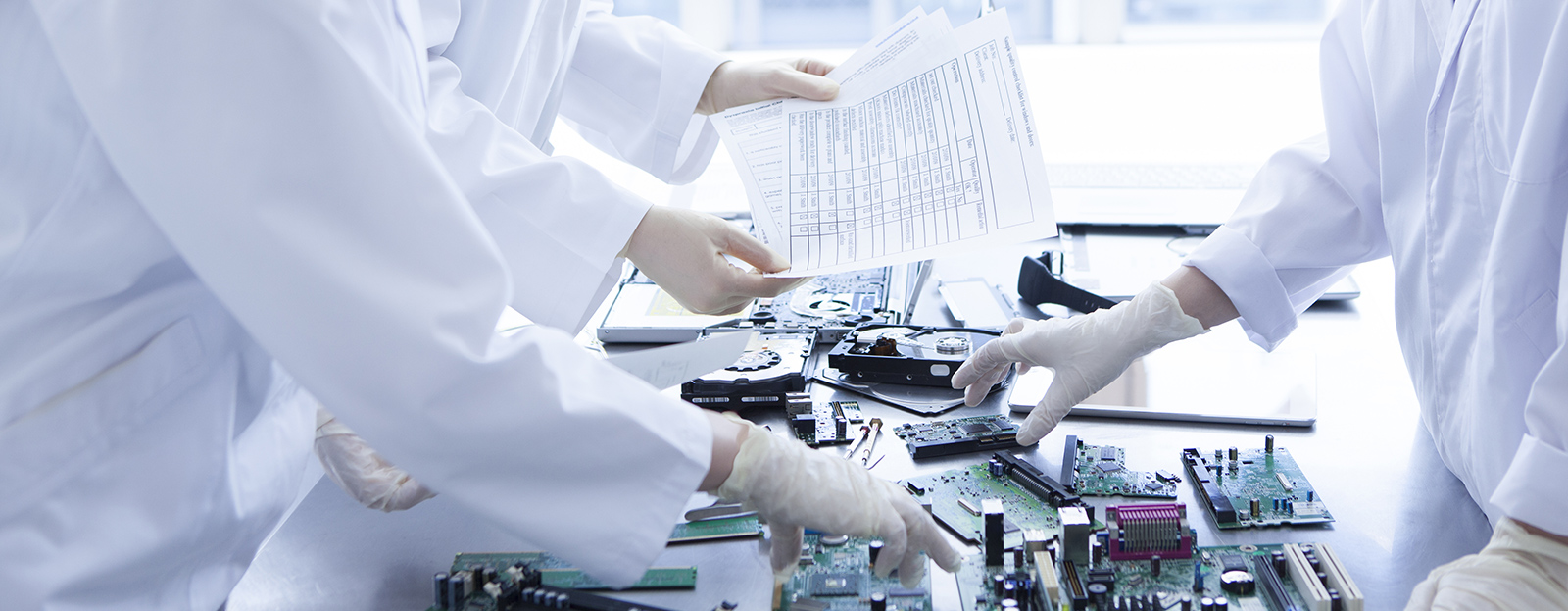
Faculty Philosophy & Concept
For modern society to continue developing sustainably toward a safe and high-quality life, it is essential to create "systems" with excellent functionality that can be used with confidence.
The Faculty of Engineering Science has "system creation" as its core concept and "creation of highly functional and safe systems in science and technology" as its basic philosophy. We primarily focus on the hardware aspects, fostering human resources involved in the construction, creation, improvement, and maintenance of industrial technology systems. To acquire truly applicable knowledge, we have developed a comprehensive education and research system that combines engineering studies with mathematics and physics—the foundations of natural science. Whether you challenge yourself through theory or contribute through technical skills, why not create "systems" that make people's lives more convenient and comfortable using your preferred approach?
What You Can Do at the Faculty of Engineering Science
Developing Human Resources to Pioneer New Frontiers (SIDE) Facing Society
Kansai University's Faculty of Engineering Science aims to develop human resources who can pioneer the new frontiers (SIDE) facing society!
Smartphone
Your familiar "smartphone" is actually created using knowledge learned at the Faculty of Engineering Science.
IoT・AI
We cultivate human resources who lead manufacturing in the AI and IoT era.
Data Science
Students develop the ability to handle useful data accurately while becoming proficient in big data utilization systems.
Environment
Learn environmental technologies toward realizing a sustainable society.
Fields of Study Supporting Smartphones
Is Mathematics a Secret Guardian?
Evolving Encryption Methods
When transmitting personal information over the internet, encryption is widely used to protect against eavesdropping (such as SSL communication). Mathematical theory is essential to this principle, and further development of this technology is expected.
Countless Radio Waves Flying Through the World.
Why Does Information Reach Properly?
Through multiplex communication using different radio wave frequencies, information reaches the recipient correctly without interference. Let's enjoy learning together about "Maxwell's equations," the fundamental law of electromagnetism, in university physics!
Smartphones Keep Getting Thinner.
What's Inside?
Through the evolution of technologies from hardware to software—including miniaturization of electronic components, batteries enabling long continuous use, and interfaces allowing intuitive operation—further miniaturization and enhanced functionality are expected to advance.
To Create User-Friendly, Durable,
and Attractive Smartphone Devices?
After examining all materials, parts are processed according to function and design and assembled into new smartphones. The development of mechanical engineering—including material development, precision processing technology, automatic assembly technology, and high-density circuit boards—is essential for smartphone development.
Global Education
Special Program for Cultivating Engineers Active in Global Society
Campus Study Abroad Experience
- General Education Courses - Global Subject Group: "Study Abroad Preparation Skill-Up Courses"
- Exchange with international students (activities, foreign language conversation, exchange events)
- Participation in overseas university visit events and international symposiums
Overseas University Experience Training (3 weeks)
- Participation in short-term residence program at Chung Yuan Christian University (2 elective credits)
- All-English seminar-style courses (2 elective credits)
Short-term Study Abroad (approx. 1-2 months)
- Overseas Internship (2 elective credits)
- Short-term study abroad and laboratory experience at Chung Yuan Christian University (Taiwan), King Mongkut's University of Technology Thonburi (Thailand), Gdansk University of Technology (Poland), etc.
International Joint Research
- Implementation of joint research themes with overseas laboratories
- Research, projects, discussions, presentations, thesis writing
- Cultivation of communication skills and problem-finding/solving abilities
Data Science Education
Creating People Who Lead Manufacturing in the AI and IoT Era
Faculty of Engineering Science Data Science Education Program
The data science education aimed for by the Faculty of Engineering Science cultivates the ability to become proficient in big data utilization systems and handle useful data accurately, with the goal of manufacturing for more comfortable living. Toward cultivating data scientists, we have constructed a new educational environment where students can systematically deepen their learning through diverse computer science courses linked to manufacturing-related subjects, PBL courses for problem-finding and solving, and corporate internships.
Ministry of Education, Culture, Sports, Science and Technology Certified Program
The Faculty of Engineering Science Data Science Education Program applied for and received certification from the Ministry of Education, Culture, Sports, Science and Technology's "Mathematics, Data Science, and AI Education Program (Applied Foundation Level)" in 2025.
(Certification Period: Until March 31, 2030)
Featured Research Reports
Report 1: Kyoto Kumihimo Featured in "Your Name" Film Debuts in Paris through Collaboration with Piezoelectric Sensors
The collaboration between "kumihimo" (braided cords), a key item in the film "Your Name," and "wearable sensors" was announced at Première Vision in Paris and became a major topic in overseas markets. This is the world's first "kumihimo sensor." It generates power through body movements such as stretching, bending, and twisting, and can transmit captured information to smartphones. As decorative accessories with ornamental knots, they can receive multiple pieces of information such as pulse and breathing from the wearer, making practical applications expected in various areas including monitoring elderly people and pets from a distance.
Report 2: Collaboration with Kyoto University Hospital - Changing the History of Endoscopic Surgery with VR
A surgical support system utilizing MR (Mixed Reality) born from a development project in collaboration with Kyoto University Hospital. Since it can be operated by voice and gaze, it is possible to make displays appear in space while wearing gloves, launch software, view electronic medical records, and perform gesture input. In endoscopic surgery, drawing lines on patient images with one's gaze enhances the surgical team's understanding, leading to reliable tumor removal. We aim for practical implementation in three years.
Department Introduction
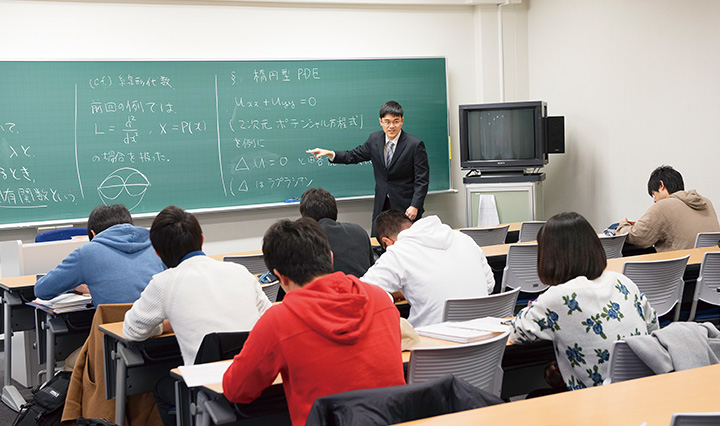
Department of Mathematical Sciences
Capacity: 33 students
From pure mathematics to applied mathematics—including algebra, geometry, analysis, and statistics—we adopt learning programs that enable students to acquire broad mathematical knowledge in small classes.
Learn More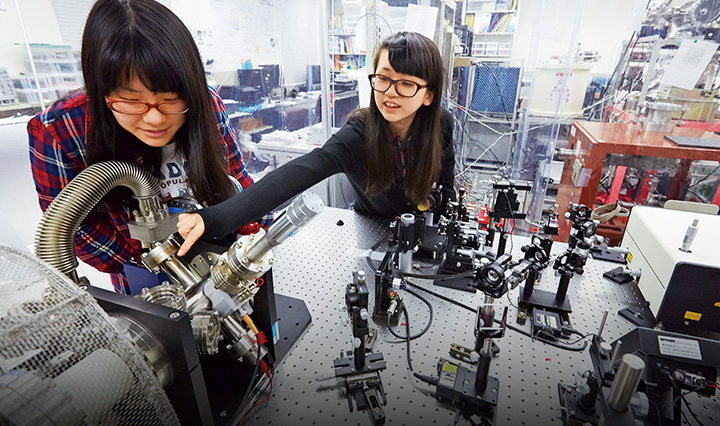
Department of Physics & Applied Physics
Capacity: 66 students
Based on physics knowledge, students learn applied physics that creates technologies useful for daily life, including energy, electronics, measurement, and materials.
Learn More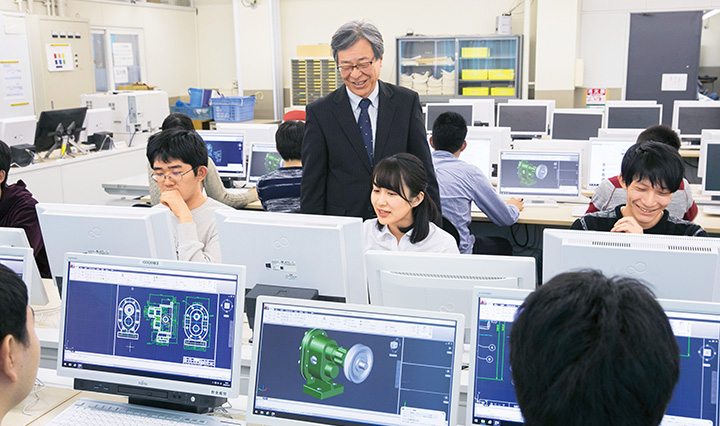
Department of Mechanical Engineering
Capacity: 220 students
From mechanical engineering fundamentals to cutting-edge technology, students comprehensively learn the knowledge and techniques necessary for manufacturing through a curriculum emphasizing experiments and practical training.
Learn More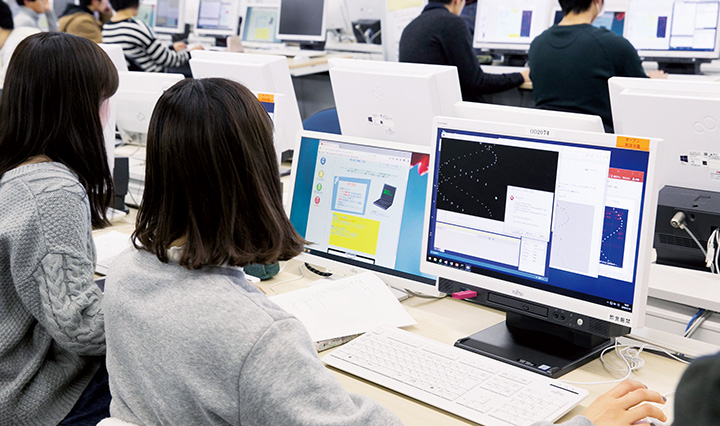
Department of Electrical & Electronic Engineering
Capacity: 182 students
Students broadly learn electrical, electronic, and information technologies that support modern society, including electronics, information communication, energy, and computers.
Learn MoreExpected Career Fields
Mathematical Sciences (Capacity: 33)
- Computer-related (Systems Engineers, etc.)
- Junior High School and High School Teachers
- Finance-related (Banks, Securities Companies, Insurance Companies)
- Information and Communication Companies
- Public Service
- Graduate School Advancement, University Researchers
Physics & Applied Physics (Capacity: 66)
- Corporate Engineers and Developers
- Researchers, Optical Properties Engineers
- Computing Engineers
- Junior High School and High School Teachers (Mathematics/Science)
- Graduate School Advancement, University Researchers
Mechanical Engineering (Capacity: 220)
- Automotive and Aviation Companies, Precision Machinery Manufacturers
- Medical Device Companies, Industrial Machinery Companies
- Electrical and Electronics Companies, Integrated Electric Manufacturers
- Measurement and Control Equipment Companies, Information Communication Companies
- Transportation Machinery Companies, Systems Engineers
- Graduate School Advancement, University Researchers
Electrical & Electronic Engineering (Capacity: 182)
- Electronics-related Companies
- Information and Communication Companies
- Computer Manufacturers and Software Companies
- Energy-related Companies
- Automotive-related Companies
- Graduate School Advancement, University Researchers