
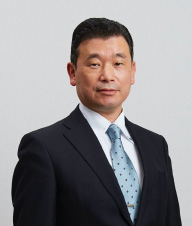
Dean, Faculty of Environmental and Urban Engineering
Professor Naoki Ikenaga
Toward a Sustainable Society Through "Community Building"
The Faculty of Environmental and Urban Engineering at Kansai University was established in April 2007 following the reorganization of its predecessor, the Faculty of Engineering at Kansai University (established in 1958).
Our faculty consists of three departments: the Department of Architecture, the Department of Urban System Engineering, and the Department of Energy and Environmental Engineering.
The basic concept of the Faculty of Environmental and Urban Engineering is "community building." Furthermore, with the basic philosophy of "creation and regeneration of 'community' spaces where citizens and production activities are integrated in urban industrial society," we aim to cultivate human resources who can demonstrate the power of science and technology to solve various problems including environmental issues facing cities and who can be active internationally.
Today's and future "communities" are built on technologies such as cities, environment, architecture, resources, energy, chemical processes, and information, and these work in coordination to create comfortable human, social, and industrial systems.
On the other hand, modern cities have brought about traffic problems and noise problems due to excessive population concentration in cities, increased industrial waste due to mass consumption of resources and energy, urban thermal pollution due to heat islands, and environmental pollution of air and water.
Furthermore, these also affect citizens living in cities, and damage to mental and physical health often appears.
The Faculty of Environmental and Urban Engineering aims to cultivate engineers who can solve these problems from scientific and international perspectives.
Toward a New Symbiosis Between Humans and Cities
Currently, in cities where many citizens live, there is a strong demand to find new ways of symbiosis between humans and cities, and it has come to be recognized as an extremely important issue in future society to transform existing urban spaces into advanced environments that emphasize human life and to construct a sustainable, safe, secure, and comfortable harmonious social system where various industrial activities can be conducted within them.
For harmony between industry, urban society, and the global environment, we must prevent environmental pollution while conserving resources and energy, build highly efficient and pollution-free production systems, and promote the recycling and resource conversion of waste.
Such basic goals of the Faculty of Environmental and Urban Engineering align with the concept of SDGs (Sustainable Development Goals), which is an international trend in recent years.
Under the Motto "Jitsugaku" (Realization of Learning)
Kansai University has a motto called "Gaku no Jitsuge" (Realization of Learning).
This is a motto advocated by Juntaro Yamaoka, the 11th President of Kansai University (1922-1925) and General Director.
This means that the university should not just end with the pursuit of truth in learning as an institution of study, but should propose what society should be and provide what it needs, thereby bridging academic principles with the industrial world and government, in other words, seeking "harmony between academic principles and practice."
It calls upon the university to return its achievements to society, and conversely, to absorb the needs in society and pursue the ideal form of learning aimed at a better society. This can be understood as the basic concept of what we now call industry-academia collaboration and industry-academia-government collaboration.
Isn't this exactly what universities today should aim for? Under this philosophy, the Faculty of Environmental and Urban Engineering at Kansai University aims for the creation and development of new "communities."