- 2026年度
- 2025年度
- 2024年度
- 2023年度
- 2022年度
- 2021年度
- 2020年度
- 2019年度
- 2018年度
- 2017年度
- 2016年度
- 2015年度
- 2014年度
- 2013年度
- 2012年度
- 2011年度
- 2010年度
- 2009年度
海外ゲストスピーカーによる講義を実施しました
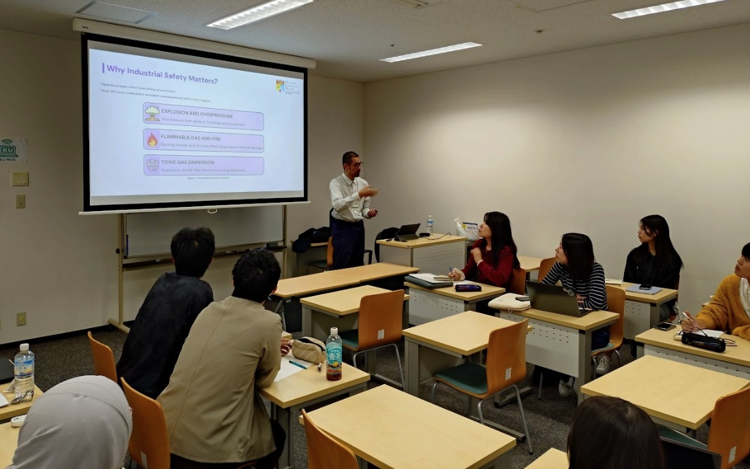
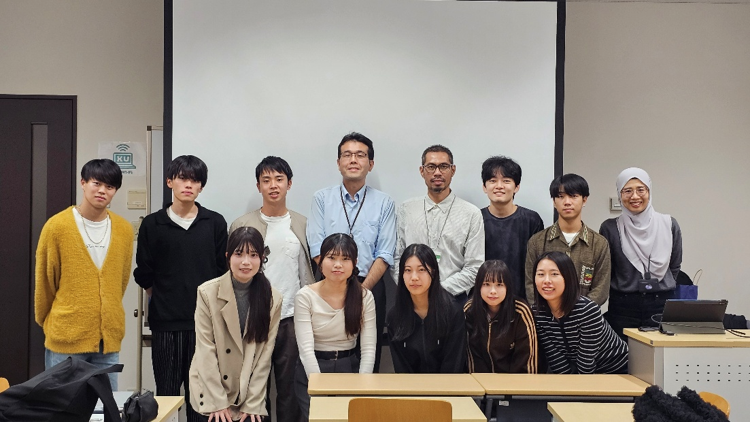
2026年10月22日、マレーシア国民大学(Universiti Kebangsaan Malaysia: UKM)工学・建築環境学部化学・プロセス工学科のMasli Irwan Rosli准教授が本学部を訪問され、学部生を対象に「Computational Fluid Dynamics (CFD) for Consequence Modelling: From Hazard Prediction to Industrial Safety(事故影響モデリングのための数値流体力学:ハザード予測から産業安全まで)」と題した講演を行いました。
Masli先生は、数値流体力学(Computational Fluid Dynamics: CFD)を用いて、事故などが発生した際にどのような影響が生じるかを予測する研究に取り組まれています。たとえば、工場のタンクから有害な化学物質が大量に漏洩した場合に、それが周囲にどのように拡散していくのかをCFDによって解析されています。
今回の講演では、CFDを用いた3つの研究事例が紹介され、その一つとして塩素ガスの拡散シミュレーションが取り上げられました。この事例では、漏洩時の拡散シミュレーションにおいて、塩素と周囲の環境との化学的な相互作用を考慮しない場合、大気中の塩素濃度を実際よりも高く見積もってしまう可能性があることが示されました。高度に専門的な内容でしたが、Masli先生は工学を専門としない学生にも理解しやすいよう工夫して講演を準備してくださいました。
本講演は、有毒ガス漏洩の際のリスクが工学的にどのようにモデル化されているのかを学ぶ貴重な機会となりました。また、Masli先生からは、こうした工学的な知見をリスクコミュニケーションに活かすなど、社会安全学部との研究協力の可能性についてもお話しいただきました。
On 22 October 2026, Associate Professor Masli Irwan Rosli from the Department of Chemical and Process Engineering, Faculty of Engineering and Built Environment, Universiti Kebangsaan Malaysia (UKM), visited our faculty and gave a lecture to undergraduate students. The title of the lecture was "Computational Fluid Dynamics (CFD) for Consequence Modelling: From Hazard Prediction to Industrial Safety."
Dr. Masli uses CFD to predict the impacts of events such as industrial accidents. For example, he analyses how harmful chemicals spread into the surrounding area when a large amount leaks from a storage tank at a factory.
In the lecture, he introduced three research cases using CFD, one of which was a simulation of chlorine gas dispersion. In this case, he showed that if a dispersion simulation does not consider the chemical interactions between chlorine and the surrounding environment, it may overestimate the concentration of chlorine in the air. Although the topic was highly technical, Dr. Masli prepared his lecture so that students without an engineering background could easily understand it.
The lecture was a valuable opportunity to learn how the risks of toxic gas leaks are modelled from an engineering perspective. Dr. Masli also talked about possible research collaboration with the Faculty of Societal Safety Sciences, such as applying engineering knowledge to risk communication.