This institute was founded in 1958 for the purpose of fostering vigorous academic research and contributing to the improvement and development of the national standard of living. As a center for joint research in the social sciences, with weight on interdisciplinary exchange and internationalization, the institute has taken up several research projects. Individual projects are undertaken by teaching staff selected from all faculties for a research period of two or four years.
At present, five research projects are conducted:
(1) Research on Urban Economy in Osaka.
(2) Research on the Socio-Economic Networking for the Sustainable Growth in East Asia.
(3) Research on Public Finance and Social Security.
(4) Research on Media and Communication in Regional Society.
(5) Research on Safety for Children and Risk Communication from a viewpoint of Social Risk Management.
Results of the research have been published in a series of bulletins, such as "Economic & Political Studies Series", "Survey & Data Series", and an "Annual Report" of public lectures and seminars.
In addition, this institute has a concurrent function as a specialized information center and is collecting basic research and statistical data as well as regular academic materials related to specialized fields of study.
Further, for the help and assistance of the local community, the institute holds open seminars on industry, public lectures, and public seminars.
The Institute of Oriental and Occidental Studies at Kansai University was founded in April 1951, with the aims of advancing the academic study of both Eastern and Western cultures, especially in comparative research, and of contributing to international harmonization among cultures. Starting as one of the first group of full-scale research institutions at Kansai University, the Institute has advanced comparative research with Asian Studies as its core, while also keeping a variety of other foreign cultures in view. Today, the Institute has four research divisions (Japan, Asia, Comparative Cultures, and Language and Philosophy) which are subdivided into eight research groups.
The Institute of Oriental and Occidental Studies 1) conducts research and publishes its findings; 2) organizes research seminars and symposia; 3) carries out projects to promote academic research; and 4) hosts scholars from overseas. The results of our research are published in the annual periodical, The Bulletin of the Institute of Oriental and Occidental Studies. Our list of publications amounts to more than 100 books, including the "Research Library" series, the "Translation and Annotation"series, the "Sources and Materials "series, the "Index " series, the " International Joint Studies" series and the " Monograph "series.
We promote our academic research and share its findings with the public, by holding research seminars, by inviting scholars from outside to hold special seminars, and by organizing international symposia.The Center for the Study of Asian Cultures was selected by the Ministry of Education Culture, Sports, Science and Technology for an Academic Frontier Research Promotion Project to be a world research center for cultural exchange study in East Asia. The Center, based on the Institute's Chinese Studies, explores various academic activities and publishes the findings of many research projects.
In order to promote an active and open research environment, and to explore new fields of study, we accept outside scholars in research exchange programs. We also have an associate research fellow system to educate young scholars, and a part-time research fellow system to accept young scholars who are working on high-level research outside academia.
In addition, we established the Memorial Association for Hakuen Academy, thanks to the donation of about 20,000 books from the renowned Chinese-study Institute in Osaka, Hakuen Academy, in 1951. We hold the annual Hakuen Lecture, and last year counted more than 50th.
We believe that the Institute of Oriental and Occidental Studies, with its comparative studies of a wide variety of cultures and its cultural exchanges throughout the world, has an even more important and relevant role in a world where the existence of civilizations and cultures, and their inter-relationship are becoming less well defined. At the same time, we should not stay within narrow boundaries, but instead expand our frontiers with a clear vision for the future. .
ORDIST was founded in April of 2002 with the purpose of contributing to the improvement of human life and the protection of the global environment through research and development of innovative science and technology. ORDIST was developed from the Institute of Industrial Technology, which was founded in 1964.
ORDIST consists of four research departments: "N" (New material, functional element and production technology), "I" (Information, communication and electronics), "B" [Bio-technology] (Life, human sciences and robotics), and "E" (Environment, energy and society). These departments have established research groups and are collaborating on innovative science and technology projects with a number of private companies.
For more advanced research, we have the following Research Centers to strategically promote specific medium- or long-term research.
In 1995, the Kansai University High Technology Research Center (HRC) was established with support from the MEXT to promote research and development which serve as the basis of future technological innovations, as well as for original research. Their scientific initiatives in the development of industrial technology are highly celebrated.
In 1997, the goals of our research groups are to establish new types of synthetic and organic engineering and urban societal systems to make a city more environmentally conscious and safer, and to contribute to the growth of cities in the 21st Century. The Frontier Science Center of Kansai University (FSC) was organized as the most advanced international core research organization of the above research fields. The MEXT considered that the Faculty of Engineering at Kansai University was one of "the Core Research Centers of Scientific Frontier Research" in which many excellent achievements have been shown and from which many future achievements were expected. Therefore they fostered the establishment of the Frontier Science Center of Kansai University to accomplish cooperative research with other research institutes.
BAC was established in 2005 with support from the MEXT to promote research and development in collaboration with industry, business, and academia.
CEMP was established in 2004. The purpose of the CEMP is to study medical and biological engineering with the collaboration between engineering, medicine and pharmacology, and to develop new methods and devices for diagnosis and therapeutics. Many collaborative research projects are being performed with medical universities and institutes.
RCRR is a research institute for regional revitalization founded in 2008.
Our mission is to gather and analyze information about regional revitalization, to investigate methods for sustainable maintenance and rehabilitation of infrastructure, and to conduct studies on regional community culture by utilizing a collaboration of the engineering field such as civil engineering and architecture, and the social science field such as public-interest policy and others. In addition, we are involved in practice for regional revitalization.
Legal studies are getting more complicated as a result of the socio-economic and international impact on legal systems. This situation requires well-organized cooperative studies by jurists, social scientists, and others. The main purpose of the Institute of Legal Studies, Kansai University (ILS, KU), founded in 1987, is to offer convenient opportunities for such joint research projects on recent complex legal and social problems.
Members of the ILS are mainly recruited from the faculties of the University, but the Institute also welcomes visiting fellows from other universities and the business world in and outside of Japan.
At present, the ILS is conducting four
research projects:
(1) Comprehensive Research on Proprietary Information Focusing India and South Africa with Specific Reference to Genetic Resource, Traditional Knowledge and Folklore.
(2) Review on the effects of the Japan-U.S. Structural Impediments Initiative: Follow-up study on the Japanese structural problems two decades after the signing of the SII.
(3) Research on Local Sovereignty
(4) Research on the exceptional situation (Ausnahmezustand)
The ILS also holds seminars, symposia, and public lectures.
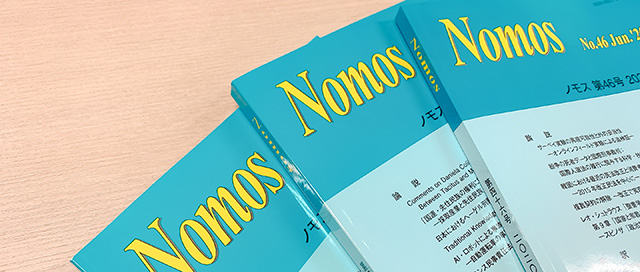
Periodicals which the ILS publishes are: Nomos (the integrated proceedings of symposia, seminars and special study meetings) and the ILS research report series.
In addition, from 2000 to 2005 we operated a large five-year project under the title "Global Financial Revolution and Law", after having received a grant from the Ministry of Education, Culture, Sports, Science and Technology-Japan (MEXT). Many leading scholars and practitioners who came not only from Japan but from all corners of the world took part in this project, and great things were accomplished.
Furthermore, we established Center for Minority Studies (CMS) from 2008 to 2013 under a project "Research to Establish the Foothold of the Studies by MEXT". CMS operated a large five-year project which were approved by and received a grant from the MEXT.
A paper of this project approved by the government notes that through considering an idea of minority, its goal is to solve "the Nation and Society" that various people conceive. It is impossible to envision the picture of nation in the 21th century without facing the hidden issue of minority.
Periodicals which the CMS publishes are; Boundary (a newsletter, twice a year) and Minority Research (a journal, once a year).
The object of the Research Institute for Socionetwork Strategies (RISS) is to create a new field of social science by utilizing advanced information and communication technology and by developing original analyzing tools. 'Socionetwork Strategies' is thus a new field of science that integrates (1) Social Science (Accounting, Management Science, and Economics), (2) Basic Science (Statistics and Mathematics), and (3) Computer Science.
RISS was adopted as “a Promotion Project for Joint Research between the Humanities and Social Science“ from the Ministry of Education, Culture, Sports, Science and Technology (MEXT), 2008-2009; modified as “a Promotion Project for Distinctive Joint Research” from MEXT, 2010.
In October 2008, RISS underwent official authorization by MEXT as a Joint Usage / Research Center. As of June 2009, five such authorized Research Centers in the field of economics exist. They include the Institute of Economic Research, Hitotsubashi University, the Institute of Social and Economic Research, Osaka University, the Institute of Economic Research, Kyoto University, the Panel Data Research Center, Keio University and RISS.
RISS has a center: “Data Mining Laboratory (DM Lab)”. DM Lab is supported by “Strategic Project to Support the Formation of Research Bases at Private Universities” with matching fund subsidy from MEXT (Ministry of Education, Culture, Sports, Science and Technology) for 2009-2013 period.
Institute of Human Rights Studies is a comprehensive research institution which aims to help promote fundamental human rights through educational programs in and outside the university.
The Institute seeks to contribute to secure the recognition and observance of human rights, by conducting research and studies on the various related issues.
The first Institute of Buraku Studies to be established in the Japanese private universities was founded in 1974. It was subsequently reorganized and renamed the Institute of Human Rights Studies in 1985. This current research institution conducts research in a variety of areas dealing with the human rights: Buraku, Ethnicity and race, People with disabilities and Gender issues. It is committed to establishing the promotion of human rights both in and outside the university; it aims to contribute toward making people aware of human rights and to make advancements in the realm of research.
Research findings are reported in publications such as "Bulletin of the Institute of Human Rights Studies" which is circulated throughout Japan to related institutions. In addition, the activities and data of the institute are outlined in the "Institute of Human Rights Studies Newsletter". There is a collection of materials dealing with human rights issues held in the institute which can be accessed by all staff and students of the university. Furthermore, it is our endeavor to put our research findings into use both within and outside the university. To achieve this, public lectures are held which are open to students, teaching staff and the general public.